Last year, I had the honor of being featured in a 10-page article in Playground Magazine. The conversation was part of an issue exploring the world of notebooks, stationery and the many ways we use paper to think, create and organise our ideas.
The story began when Auste Skrupskyte Cullbrand, Playground’s editor-in-chief, got in touch to tell me she loved my booq notebook collection — apparently, they were the only notebooks she had ever used completely from cover to cover. She then asked whether I would be interested in co-creating a notebook together.
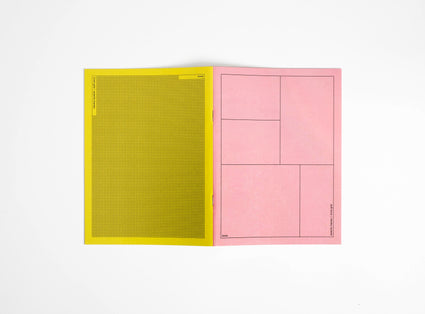
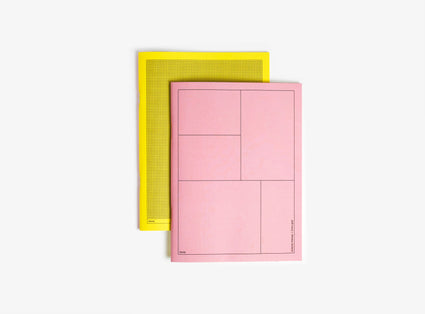
I immediately loved the idea. The result is the Edition Julie Joliat x Studio Playground notebook, which you can see here.
 © Natasha auf'm Kamp
Excerpt from the conversation between Julie Joliat and Auste Skrupskyte Cullbrand, originally published in Playground Magazine Issue 4, November 2025:
[…]
How did your love for design first start?
It goes back to childhood. I was already designing small magazines for my Barbie dolls and building miniature furniture. I loved drawing, so I went to art school - it felt very natural. Growing up in a small village, I didn't even know what graphic design was. At 12, I tried a few days internship at a local newspaper and realised I didn't just want to execute other people's layouts - I wanted to design them. Later on, I realised that was graphic design, and that this could be my path.
You've lived and worked across Switzerland, the Netherlands, France, and Germany. How did these countries shape your perspective?
The Netherlands influenced me most. During my studies, a teacher showed us Dutch stamp design, and I was fascinated by how free and experimental it felt compared to Swiss graphic design. After my studies, I did some internships in the Netherlands and fell in love with their approach. Later, back in Switzerland, I rediscovered Swiss design through people who admired it. Over time, people described my work as a blend of Swiss precision and Dutch playfulness.
You've designed books, magazines, posters, brand identities - and eventually created your own stationery brand. How did that begin?
It started with a personal project. When I left the Netherlands, I wanted to give a souvenir to friends and people I met there, and also needed a planner for myself, since nothing on the market fit my taste - back then it was mostly Moleskine. So I made my own, I printed 200 copies, gifted half away, and sold the rest. Shops were surprisingly interested, and it slowly grew from there. For a long time, it was a side project and I was only doing a planner, until I moved to Berlin and realised it could be something bigger. That's when I decided to build the brand more seriously.
Your planners are not just blank pages - they invite play and experimentation. How did that approach develop?
It happened unconsciously. I see things and think, "It's nice, but this could go further." Each planner has a theme or prompt because I wanted it to stay fun and experimental. I've always set myself the rule: if it stops being fun, I'll stop making it. That mindset allowed me to treat each project as a playground.
 © Natasha auf'm Kamp
Love that! […] From planners you expanded to notebooks. What's your favourite type?
The ones I designed for myself (laughs). I wanted them not too thick with smooth paper and formats I'd actually use. Sometimes lined, sometimes blank - it depends. I still rotate between them. I also collect notebooks, buying them for their paper or cover.
Do you consider yourself a stationery geek then?
A little, but there are bigger geeks than me! I'm as much a collector of beautifully made books as I am of notebooks. It's about the object itself. I'll often buy things for their paper quality, binding, or printing techniques - even if I never write in them. They inspire me.
Which stationery brands get your creative juices flowing?
Definitely Japanese ones, like
Midori,
Stalogy, or
Kleid stationery. Their paper is incredible, nothing compares. I also love browsing ordinary stationery shops abroad - you often find treasures in unexpected places.
 © Natasha auf'm Kamp
If you could take us to one destination for stationery Lovers, anywhere in the world, where would it be?
Present & Correct, although I've never been there. In Berlin, I love places like
RSVP,
Luiban, the newly opened
Gosori or
Modulor. In Paris, I've found amazing notebooks at
Merci. But honestly, I love "Brocki" shops in Switzerland - second-hand stores where you sometimes find discontinued student notebooks from the 1970s. They're treasures with beautiful paper you can't find anymore. […]
How do you see the Edition Julie Joliat brand evolving?
I'd like to expand with more products and release them on a more regular basis. I always have plenty of ideas, but being alone, I'm not as fast as I would like too. So my dream is keep on doing nice products and grow steadily. And hopefully hire people! (laughs) […]
(End of excerpt)
If you don't know
Playground yet, you should absolutely take a look. It's a magazine offering insightful glimpses into Europe's creative scene. Each issue explores one theme with an open and curious eye, and Issue 4 includes a deep-dive chapter dedicated to the world of notebooks. A must-read if you're a stationery lover, or simply interested in the many ways paper can become part of our creative process.
 © Jurga Sako
The Edition Julie Joliat x Studio Playground notebookAs part of the project, we created a
collaborative notebook inspired by the spontaneous ways people take notes. The Playground team researched how people actually use paper when they're thinking: scribbles, lists, quick tables, diagrams, arrows and all the little structures we instinctively create to organise our thoughts.
The first idea was to turn these discoveries into neat, carefully designed templates. But the more we looked at the original notes, the more interesting they became. The imperfect circles, uneven arrows, spontaneous tables and little visual accidents already had their own kind of beauty. So instead of redesigning them, I kept the original drawings almost exactly as they were, removing only the text.
The result is a notebook that feels playful and intuitive, with unexpected prompts and structures scattered throughout the pages. It's a tribute to note-taking — and, in a small way, a gentle rebellion against it.
Keep making notes,
Julie